
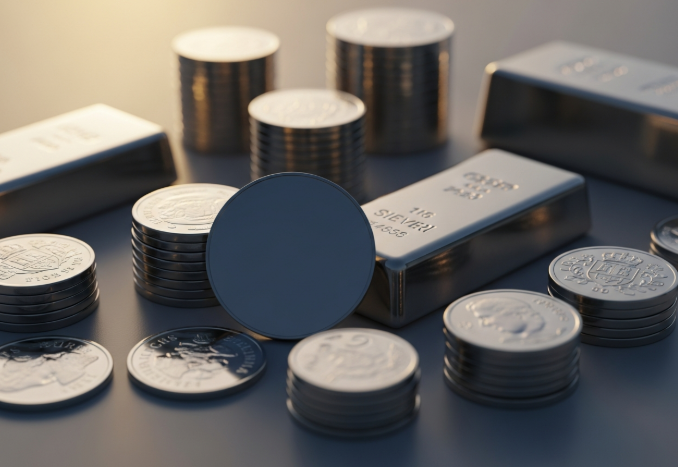
The Troy Ounce Itself
The history behind why the price of silver per ounce became the global standard, and what that convention obscures when applied to a metal traded in dramatically different forms across different regions, is worth understanding in some detail. Dealers such as SD Bullion publish their charts in the standard convention, but the global reality is messier than the single number suggests, and the messiness occasionally matters for buyers operating across borders or comparing quotes from different sources.
A troy ounce is not the same as the ounce used in everyday American measurement. The avoirdupois ounce, familiar from grocery stores and cooking recipes, weighs roughly 28.35 grams. A troy ounce, used exclusively for precious metals, weighs roughly 31.10 grams. The difference is small but not negligible, and it has caught more than a few new buyers who weighed a coin on a kitchen scale and concluded their dealer had shorted them. The troy ounce traces back to medieval European trade, with the name probably derived from Troyes, the French market town where the standard emerged. When the bullion market formalized in modern times, the troy ounce was already so deeply embedded in precious metals commerce that no serious effort to displace it has ever gained traction.
Why the Convention Persists Despite Global Trade
Most other commodities are quoted in metric units in international markets. Oil trades by the barrel for legacy reasons but its underlying volumes are calculated in liters and cubic meters; copper, aluminum, and most industrial metals trade in metric tons. Silver and gold are conspicuous exceptions. The persistence of the troy ounce reflects the dominance of London and New York as the centers of price discovery for precious metals, and the willingness of the rest of the world to denominate transactions in the units those markets use. Buyers in Switzerland, Germany, Japan, and China all transact in their local currencies and often think in grams or kilograms, but the underlying reference price they hedge against and benchmark to is the per-troy-ounce figure published by London and New York. The convention is inconvenient for some users and natural for others, but its grip on the market shows no sign of loosening.
What the Per-Ounce Number Obscures Internationally
Asian markets often trade silver in kilograms, with the standard physical unit being the one-kilo bar that contains roughly 32.15 troy ounces. European retail buyers frequently see silver quoted in grams for small purchases. Indian buyers think in kilograms and grams when discussing the metal in everyday conversation. A buyer comparing prices across these regions has to convert constantly between units, and the conversion is occasionally where pricing differences hide. A kilo bar that appears cheap on a per-ounce calculation may carry premiums that look different in the buyer’s local thinking, and vice versa. International buyers who shop across multiple regions develop a fluency in unit conversion that domestic buyers rarely need, but the fluency is genuinely useful for spotting pricing dislocations.
The Per-Ounce Quote Versus the Reality of Most Retail Products
The headline per-ounce figure refers to wholesale large-format silver, typically the thousand-ounce good delivery bars that institutional participants actually trade. Retail buyers transact in much smaller units: one-ounce coins, one-ounce bars, ten-ounce bars, occasionally kilo bars. The per-ounce price of these retail products is meaningfully higher than the headline wholesale figure because of the fabrication, distribution, and dealer margin that gets added at each step. A one-ounce Silver Eagle priced at six dollars over spot is not the same as silver itself trading at six dollars higher; it is the per-ounce cost of the retail product, which differs structurally from the per-ounce cost of the wholesale metal underlying it. Buyers who understand this distinction shop more intelligently than those who anchor on the headline figure as if it were the actual retail cost.
The Per-Gram and Per-Kilo Conversions Worth Knowing
For anyone operating across multiple unit conventions, a few mental anchors save constant calculator use. One troy ounce equals roughly 31.10 grams. One kilo equals roughly 32.15 troy ounces. A per-gram quote can be roughly converted to per-ounce by multiplying by 31; a per-kilo quote can be roughly converted to per-ounce by dividing by 32. These approximations are accurate enough for shopping comparisons and quickly become second nature for buyers who use them regularly. More precise calculations require the exact conversion factor, but the rough versions catch most meaningful pricing differences without requiring constant precision.
The London Bullion Market Association and the Royal Mint both publish reference materials that document the historical evolution of these measurement conventions, and any of the standard precious metals reference works contains the formal conversion tables that practitioners use daily.
How Currency Effects Combine With Unit Conventions
A non-American buyer reading the per-ounce silver price in US dollars has to convert through two different systems to arrive at the local cost: the currency conversion from dollars to local currency, and potentially a unit conversion from troy ounces to whatever local convention applies. The combined effect can produce headline prices that move in surprising ways. A weakening dollar might push the dollar-denominated silver price higher even as the price in euros or yen barely moves, because the local-currency strength offsets the metal’s apparent rally. International buyers who track silver only through US-denominated charts miss this dynamic and occasionally make decisions based on what looks like a strong rally but is actually a dollar move in disguise. Dual-currency tracking, with the metal expressed in both dollars and the buyer’s home currency, eliminates this confusion.
The Premium Question Across Different Units
Premium structures differ across formats and unit conventions in ways that occasionally favor unusual purchases. A one-gram bar from a reputable refiner carries premiums per ounce that are dramatically higher than the same refiner’s one-ounce bars, because the fabrication cost is spread over so much less metal. A one-kilo bar carries premiums per ounce that are dramatically lower than a one-ounce bar, because the fabrication efficiency improves with size. Buyers who think in pure per-ounce terms but actually shop across these formats sometimes pay considerably more than necessary by defaulting to one-ounce units when a kilo bar would have served the same purpose at much lower premium cost. The per-ounce convention obscures the format-dependent premium structure that actually determines what the buyer ends up paying.
The Useful Conclusion
The per-ounce quote is convenient, deeply embedded, and not going away. What changes when an investor understands its limits is how the quote gets used. A reader who knows that the headline figure refers to wholesale large-format silver, that it sits above considerably higher per-ounce costs for retail products, that it interacts with currency moves for non-American buyers, and that it obscures the premium efficiency of different formats reads the same quote with much more nuance than a reader who takes it at face value. The metal itself is identical regardless of how it is measured or priced. What differs is the quality of decision-making the buyer brings to acquiring it, and that quality is shaped by exactly the kind of contextual understanding that the headline per-ounce number alone never provides.


