
Table of Contents
- Start With Your Personal Buyer Profile
- Compare the Daily Feel, Not Just the Listing Photos
- Match the Property Type to the Full Cost of Ownership
- Review Flood and Insurance Questions Early
- Check Schools, Services, Access, and Future Development
- Use Neighborhood-Level Market Comparisons
- Match Miami Neighborhood Types to Your Goals
- Create a Simple Neighborhood Scorecard
- Final Checklist Before Making an Offer
In Miami, Florida, two homes with similar price tags can create entirely different ownership experiences. One may place you near restaurants, parks, bayfront paths, and major employment centers, while another may offer more interior space, quieter streets, or a different maintenance profile. The goal is not to find a universally perfect neighborhood. It is to find one that supports the way you expect to live after closing.
Buyers comparing homes, condominiums, townhouses, and waterfront options can begin with Coconut Grove Homes for Sale, a searchable listing resource from the Hidy Homes Team. The team focuses on Miami-area real estate and provides neighborhood-focused home searches for Coconut Grove as well as nearby Coral Gables, Miami, and Miami Beach, making the page a useful starting point for comparing local property styles, locations, and features.
Start With Your Personal Buyer Profile
A neighborhood comparison becomes more useful when it starts with your routine instead of a list of attractive homes. A remote worker may prioritize a quiet office space and easy errands. A household with school-age children may give more weight to daily travel patterns and services. A second-home buyer may prefer a building with amenities and less exterior maintenance.
- Set a total monthly housing budget, including estimated insurance, taxes, association fees, and maintenance.
- Decide on the longest commute or travel time you can accept regularly.
- Rank access to parks, marinas, beaches, grocery stores, dining, healthcare, and cultural activities.
- Choose the property types that fit your lifestyle: condominium, townhouse, detached home, or waterfront property.
- Consider privacy, walkability, parking, outdoor space, and plans to stay for several years or longer.
Compare the Daily Feel, Not Just the Listing Photos
Coconut Grove can feel different from Brickell, Coral Gables, Miami Beach, or more suburban parts of Miami-Dade County, even when homes share similar square footage. Visit any neighborhood under consideration at least three times: on a weekday morning, during an evening commute, and on a weekend. This helps reveal traffic patterns, street activity, parking conditions, noise, and the pace of local life.
Questions to Ask During Each Visit
- Can you comfortably walk to the places you would use each week?
- Do nearby streets feel calm, active, commercial, or heavily traveled?
- Is there convenient access to green space, the waterfront, bike routes, or public transit?
- Would the area still work if your household, work schedule, or transportation needs changed?
- Does the property itself have a different feel during rush hour, school pickup, or weekend activity?
Match the Property Type to the Full Cost of Ownership
Home type and neighborhood are closely connected. A condominium may offer shared amenities and shift exterior responsibilities to the association, but buyers should review fees, building rules, reserves, insurance arrangements, and possible assessments. A townhouse may provide more separation and space while still involving an association. A detached home can offer greater control over improvements, landscaping, and privacy, while placing more maintenance responsibilities on the owner.
Compare each option beyond its asking price. Request available association documents, estimate property taxes and insurance, identify parking or storage charges, and ask about roof, exterior, landscaping, pool, seawall, dock, or mechanical-system responsibilities when relevant. For waterfront and coastal-area properties, include storm preparation and ongoing maintenance in the budget from the beginning.
Review Flood and Insurance Questions Early
Flood exposure and insurance should be early due diligence items rather than last-minute concerns. Start by reviewing the property location and available flood hazard information through the FEMA Flood Map Service Center, then speak with qualified insurance professionals about the coverage and underwriting details that apply to the specific home. Map information is useful, but it is not a substitute for property-specific advice.
- Request insurance estimates before submitting an offer when possible.
- Ask whether flood coverage is separate from a standard homeowners policy.
- Review wind-mitigation features, roof information, openings protection, and storm-readiness improvements.
- Ask the seller about known prior water intrusion, drainage issues, repairs, and storm-related work.
- Use inspections and professional guidance to understand the condition of the individual property.
Check Schools, Services, Access, and Future Development
Nearby services can shape both convenience and buyer demand. Review the routes you would take to work, school, medical care, grocery stores, airports, Downtown Miami, Brickell, Coral Gables, or the beach. If schools matter to your decision, verify current boundaries, enrollment procedures, programs, and transportation details directly with the appropriate school system or school.
Also, look beyond the lot line. A vacant parcel, low-rise commercial site, or underused property nearby may change over time. Miami-Dade County explains that zoning classifications identify permitted land uses and development conditions, so buyers can use the county’s zoning district information to begin understanding permitted uses, height, area, open space, and setback rules. Review pending applications and public planning information where available, especially when views, privacy, traffic, or parking are central to your decision.
Use Neighborhood-Level Market Comparisons
Citywide averages rarely tell the whole story. A meaningful comparison looks at recent closed sales for homes that are similar in location, condition, size, age, and property type. Condominium buyers should also compare buildings separately, since fees, amenities, maintenance history, rules, and views can vary considerably within the same neighborhood.
- Recent comparable closed sales.
- Active competition for similar homes.
- Time on market and price changes.
- Price per square foot is one comparison point, not the only one.
- Association costs, rental restrictions, and ownership requirements when applicable.
- Features that may influence future appeal, such as parking, outdoor space, water access, or walkability.
Match Miami Neighborhood Types to Your Goals
Rather than searching for the “best” Miami neighborhood, compare neighborhood types against your priorities:
- Walkable urban areas: Often fit buyers who want dining, entertainment, transit options, and proximity to work centers.
- Established residential areas: May suit buyers seeking quieter streets, more privacy, and a detached-home setting.
- Waterfront communities: Can appeal to buyers who value bay views, boating access, and outdoor living, while requiring careful review of maintenance and insurance considerations.
- Condominium-centered districts: May work well for buyers who prefer shared amenities and reduced exterior upkeep.
- Suburban communities: Often appeal to households seeking additional space, parking, and a slower daily rhythm.
Create a Simple Neighborhood Scorecard
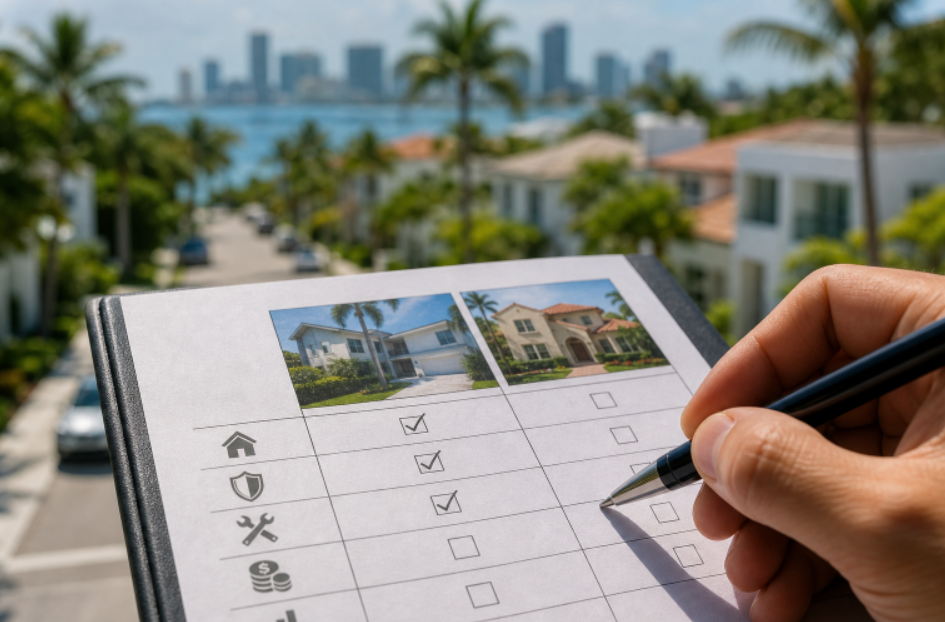
After every showing, give each category a score from one to five and add a short note explaining the score:
- Commute and access to routine destinations.
- Walkability and ease of daily errands.
- Insurance, drainage, and storm-preparation considerations.
- Property type, maintenance needs, and association responsibilities.
- Schools, healthcare, shopping, and other essential services.
- Noise, privacy, parking, and overall community feel.
- Potential resale appeal or rental suitability, if relevant to your plans.
Final Checklist Before Making an Offer
- Compare at least three neighborhoods, not just three homes.
- Visit finalists at different times and on different days.
- Review the full monthly cost, not only the mortgage payment.
- Check insurance questions, flood information, and property condition early.
- Verify schools, travel routes, services, zoning, and nearby development activity.
- Use recent, comparable sales to evaluate value in the immediate area.
The right Miami neighborhood should fit your present routine and leave room for future plans. When lifestyle, access, ownership costs, property type, insurance considerations, and local development are evaluated together, buyers can make a decision based on the reality of daily life rather than the first impression of a beautiful home.


