
Key Takeaways
- Shock-absorbing casters can improve equipment mobility and reduce vibration.
- Proper caster selection should consider load, flooring, noise, and operating conditions.
- Application-specific specifications are more important than catalog load ratings alone.
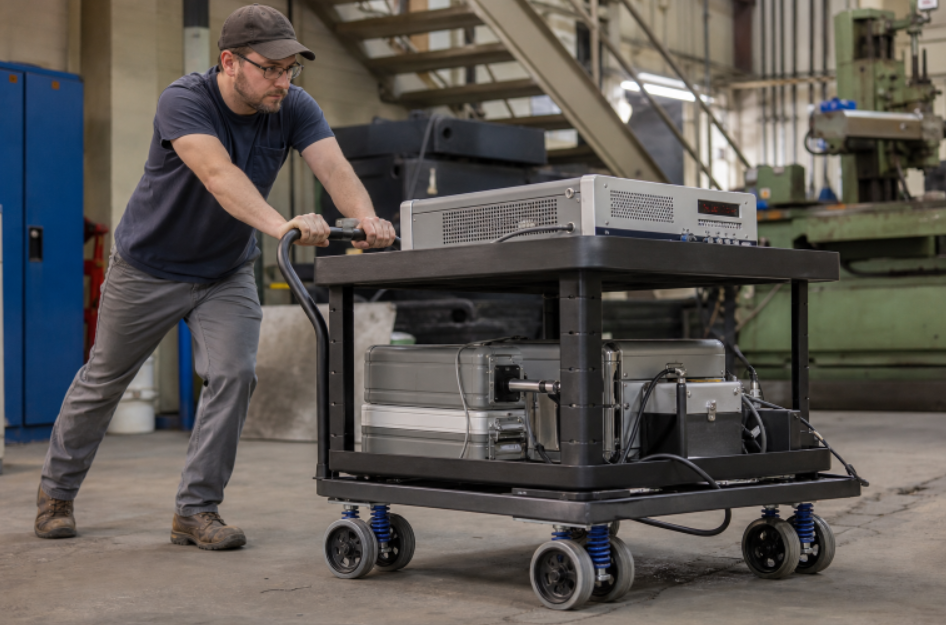
Moving heavy, fragile, or high-value equipment over imperfect floors can introduce impacts that travel directly into the load, cart frame, wheels, and surrounding work area. R.T. Laird, Inc. addresses this challenge with spring-loaded caster designs intended to isolate movement-related shock and reduce vibration. For applications that need both stable load support and more controlled travel, dual wheel shock absorbing casters can be an important part of the equipment design.
Rather than treating a caster as a simple rolling component, buyers should consider it part of the overall movement system. A caster must support the operating load, roll across the actual surface, turn as required, fit the mounting arrangement, and help protect the payload from the jolts created by seams, thresholds, debris, ramps, and damaged flooring.
Why Do Conventional Casters Struggle on Uneven Industrial Surfaces?
Rigid casters and lightly cushioned wheels can transfer impact to equipment during bumps or floor joints, causing abrupt motion, noise, wheel wear, or stress on components. These issues are common when moving carts frequently or with costly-to-repair equipment. Shock control depends on more than load ratings; factors like wheel material, size, tread, suspension, caster design, center of gravity, speed, and floor condition affect performance. A heavy load may be stable when stationary but experience harsh forces when moving on uneven surfaces. Research shows caster configuration influences movement; peak acceleration and shock pulse are key in evaluating wheel arrangements and suspension, though no single design suits all applications. Dual-wheel casters, with two wheels in one assembly, distribute load more evenly and offer greater stability, ideal for heavy, wide, or sensitive loads where floor loading and controlled movement are vital.
The dual wheel arrangement and shock-absorbing mechanism serve related but distinct functions. The wheels help support and distribute load. The spring-loaded suspension helps manage the shock and vibration transmitted from the floor into the equipment. Together, these features can help a properly specified cart move more smoothly through demanding work environments.
- Load distribution: Two wheels can spread supported weight across more than one contact point.
- Stability: A dual wheel configuration may be beneficial for equipment with a broad footprint or a demanding center-of-gravity profile.
- Floor protection: Appropriate wheel and load selection may help limit concentrated contact stress on finished floors.
- Shock management: A suspension system can reduce the harshness of impacts caused by surface irregularities.
- Application flexibility: Wheel material, mounting style, braking needs, and swivel requirements can be matched to the operating environment.
What Performance Benefits Does R.T. Laird, Inc. Report?
R.T. Laird, Inc. reports that its spring-loaded shock-reducing casters can reduce shock and vibration by up to 80 percent and lower noise levels by as much as 25 decibels. The company also identifies reduced wheel wear, less damage to floor surfaces, and better protection for delicate products and material-handling equipment as potential benefits.
These are company-reported performance figures, not universal guarantees. Actual results depend on the selected caster model, weight carried by each caster, travel speed, wheel type, floor profile, mounting method, load placement, and maintenance condition. Buyers should review their application details with R.T. Laird, Inc. before relying on a projected reduction level.
Which Equipment Applications Can Benefit From Shock-Controlled Movement?
Shock-absorbing caster systems are crucial where equipment needs to move without exposing people, products, or machinery to impacts. R.T. Laird, Inc. serves food service, computer, aviation, aerospace, and other industrial markets. Applications include industrial carts, mobile workstations, electronic and aviation support equipment, precision instruments, and fragile components. For instance, a cart with sensitive instruments crossing expansion joints requires smooth movement. Suspension travel reduces impact force compared to rigid frames, allowing controlled vertical movement over obstacles and demonstrating the significant effect of suspension design on shock transmission.
What Should Buyers Specify Before Ordering?
A complete application description helps avoid under-specification. Before selecting a dual wheel shock-absorbing caster, document the conditions the equipment will experience in actual use:
- Total operating load: Include the equipment, payload, accessories, and expected dynamic loading.
- Number of load-bearing casters: Account for uneven load distribution during turns, on ramps, or at floor transitions.
- Travel surface: Identify concrete, tile, epoxy, grating, thresholds, joints, debris, ramps, and outdoor exposure.
- Travel speed: Higher speeds can increase impact forces when wheels meet obstacles.
- Turning and braking needs: Define the requirements for swivel, rigid, directional-lock, wheel-brake, and total-lock.
- Mounting details: Confirm plate dimensions, bolt pattern, stem type, clearance, and required overall height.
- Environmental exposure: Consider moisture, cleaning processes, chemicals, temperature, corrosion, and sanitation needs.
- Payload sensitivity: Identify electronics, instruments, fragile parts, or people that require controlled movement.
How Does Application-Specific Selection Improve Results?
Choosing the best caster involves reviewing the entire system, not just capacity. R.T. Laird, Inc., with over four decades of experience and made in the U.S., focuses on shock isolation and noise reduction. An application discussion can help select the right dual-wheel setup, wheel material, or suspension for actual conditions. No caster can prevent all shocks; poor floors, high speed, wrong mounting, overload, uneven payload, or lack of maintenance affect performance. Regular checks of wheels, bearings, fasteners, brakes, and suspension are vital for safe, predictable movement.
Frequently Asked Questions
Are dual wheel casters always better than single wheel casters?
No. Dual-wheel casters may improve load distribution and support stability in some applications, while single-wheel casters can be appropriate where clearance, maneuverability, or a different wheel profile is more important. Selection should follow the actual load, surface, and movement requirements.
Can shock-absorbing casters reduce operating noise?
They can help reduce noise created by impacts and harsh rolling conditions. R.T. Laird, Inc. reports noise reductions of up to 25 decibels for its shock-reducing caster solutions, depending on application conditions.
When should an engineering review be requested?
An engineering review is especially valuable for heavy, expensive, fragile, unusually shaped, or frequently moved equipment. It is also useful when carts must cross rough floors, ramps, thresholds, or other recurring obstacles.
Conclusion
R.T. Laird, Inc. offers a practical starting point for organizations seeking more controlled movement of heavy or sensitive equipment. Dual-wheel shock-absorbing casters can combine load-support benefits with spring-loaded shock isolation, helping buyers address vibration, noise, wheel wear, floor contact, and payload protection as part of a single equipment mobility strategy. The best outcome depends on careful specification, realistic operating information, and selecting the caster system for the application rather than the catalog rating alone.


